

Africa’s Crypto Market Matures: Fraud Rates Drop by 28% – New Sumsub Report
The continent is leading verification gains as the global industry enters a regulatory maturity era and prioritises user onboarding accuracy over speed
Africa’s crypto ecosystem is entering a phase where operational discipline matters more than momentum.”
JOHANNESBURG, GAUTENG, SOUTH AFRICA, March 19, 2026 /EINPresswire.com/ -- Crypto platforms across Africa are rapidly improving identity verification performance as the industry moves toward stricter regulation and stronger fraud prevention. — Hannes Bezuidenhout, VP of Sales Africa at Sumsub
These findings are based on Sumsub, a leading full-cycle verification platform that enables scalable compliance, which today released its fourth annual State of the Crypto Industry report*. The new research reveals how crypto companies are balancing fraud prevention, regulatory pressure, and user experience as they scale in 2026. This report draws on Sumsub’s internal data from 2024–2025 and insights from 300 crypto companies surveyed outside Sumsub’s customer base.
Globally, 74% of crypto providers now prioritise verification accuracy over onboarding speed (39%), signalling a shift away from the “growth at all costs” model that defined the sector’s early expansion.
The report says the industry is entering a phase of “regulated maturity,” where compliance, fraud prevention, and user experience are increasingly integrated into core product design rather than treated as separate operational layers.
The improvement reflects the region’s mobile-first fintech ecosystem, where onboarding processes are increasingly optimised for smartphone users and digital identity tools.
“Africa’s crypto ecosystem is entering a phase where operational discipline matters more than momentum,” said Hannes Bezuidenhout, VP of Sales Africa at Sumsub. “As platforms scale, the focus is shifting from how fast they can grow to how effectively they can operate under increasing regulatory scrutiny. Compliance, fraud resilience, and onboarding efficiency are becoming interconnected challenges that must be addressed together.”
The trend is particularly visible in major crypto adoption hubs, including South Africa, Nigeria, Kenya, Ghana, and Mauritius, where fintech innovation, digital payments adoption, and regulatory reforms are reshaping the digital asset landscape.
The findings highlight how Africa’s fast-growing digital finance ecosystem is adapting to a more regulated environment while maintaining strong user onboarding performance.
Fraud dynamics vary across African crypto markets
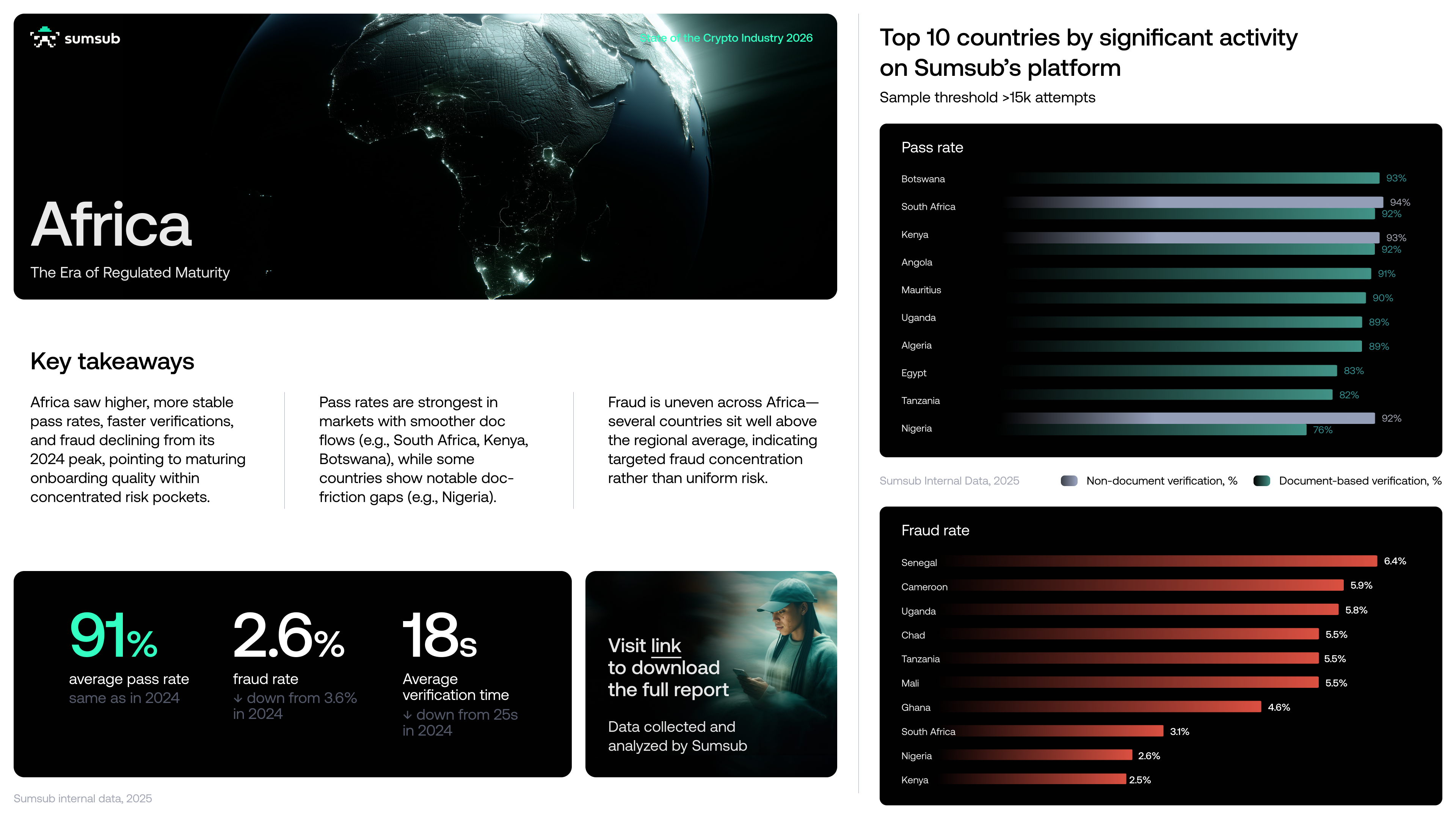
While fraud remains a global challenge, the report shows evolving patterns across African markets as crypto adoption accelerates. Across the continent, average fraud rates rose from 1.7% in 2023 to 3.6% in 2024, before declining to 2.6% in 2025, representing a 28% year-on-year drop.
However, fraud dynamics vary across key markets, with Ghana recording a fraud rate of 4.6%, South Africa 3.1%, Nigeria 2.6%, and Kenya 2.5%.
The report points out that the continent remains a target for scams and mule-account recruitment, particularly as crypto usage expands alongside mobile payments and digital banking platforms. In some parts of the continent, fraud rates were extremely high in 2025, exceeding 5% of all verification attempts in Mali, Tanzania, Chad, Uganda and Cameroon, while reaching the regional maximum of 6.4% in Senegal, despite the overall improvement in regional fraud rates.
The report highlights several global trends that are also influencing Africa’s digital asset ecosystem.
Among the key findings:
- 57% of providers cite AI-powered fraud detection as their top security priority.
- Average global fraud rates stabilised at 2.2% in 2024-2025, after rising from 1.5% in 2023, with striking regional variations, such as a significant 65% rise in APAC (climbing to 3.3%) or a sharp -38% decline across North America (down to 1.6%).
-55% of crypto platforms reported fraud incidents in 2025, while 15% were unsure whether fraud had occurred, highlighting detection challenges.
The report also notes that implementation of the Travel Rule, which requires crypto platforms to share sender and receiver information for transactions, remains uneven globally, with only 23% of providers reporting full compliance.
At the same time, several African governments are introducing new regulatory frameworks aimed at bringing digital assets under formal financial oversight.
Key developments highlighted in the report include:
-South Africa implemented the Travel Rule directive in 2025 and introduced the Crypto-Asset Reporting Framework (CARF) tax reporting regulations from March 2026.
-Nigeria passed the Investments and Securities Act 2025, formally recognising virtual assets as securities under the supervision of the Securities and Exchange Commission.
-Kenya’s Virtual Asset Service Providers Act establishes licensing requirements under the Capital Markets Authority and the Central Bank.
-Ghana is preparing Virtual Asset Service Providers legislation, expected to introduce oversight by the Bank of Ghana and the Securities and Exchange Commission.
-Mauritius continues to strengthen its digital asset framework as part of its strategy to position itself as a regulated global financial centre.
These regulatory developments signal a broader shift toward formal oversight of digital assets across Africa, as governments seek to balance innovation with stronger financial crime controls.
Another notable trend is UX merging with compliance, increasing popularity in Non-Doc and Reusable Identity solutions among future-oriented crypto platforms: the former refers to document-free user onboarding, and the latter allows to verify clients across multiple platforms without repetitive document uploads. Across Africa, the highest user pass rates in 2025 referred to the Non-Doc verification method: 92% in Nigeria, 93% in Kenya and 94% in South Africa. In 2026, high pass rates are expected to be maintained alongside compliance requirements in increasingly complex cross-border onboarding scenarios.
The figures reflect both rapid crypto adoption and growing investments in verification infrastructure across Africa’s leading digital finance markets.
AI is reshaping both fraud and fraud prevention
Artificial intelligence is becoming a defining factor in the next stage of crypto security.
“Attackers are using automation and generative tools to scale fraud attempts faster than ever,” Bezuidenhout added. “Defenders need systems that can respond in real time across identity, behaviour, and transaction data.”
According to the report, the strongest competitive advantage for crypto platforms in 2026 and beyond will come from integrated systems that continuously learn across the entire user lifecycle.
The next phase of crypto growth
The report concludes that sustainable expansion of the crypto sector will depend on embedding compliance directly into product architecture.
Crypto has entered a regulated maturity era: growth in 2026 is defined by regulatory scrutiny, sophisticated fraud pressure, and competition to deliver compliant, low-friction onboarding at scale.
“Regulated maturity means building better systems, not just adding more rules. The platforms that win will be those that embed verification into their product DNA and wrap automation in strong controls, transparency, and accountability,” explains Ilya Brovin, Chief Growth Officer at Sumsub. "In the era of AI agents, the central dilemma is how AI-powered verification vendors continuously outmanoeuvre AI-driven fraud without eroding user experience or auditability. Those who solve this dynamic won’t just meet regulatory expectations — they’ll define the next standard of trust in crypto.”
To get the full State of the Crypto Industry 2026 report, please check https://sumsub.com/crypto-industry-report-2026/
* Note on Sumsub’s research methodology
The study combines three main data pillars: 1) internal identity verification and user activity data from 2023 to 2025, covering pass rates, verification time, and fraud attempts across various regions, based on over 23,000 fraud attempts analyzed daily; 2) results of Sumsub’s Crypto Industry Research Survey 2025, which features responses from 300+ companies across the crypto sector outside Sumsub’s customer base, including centralized exchanges, wallets, payment providers, on/off‑ramps, and token issuers; 3) external publicly available regulatory and policy data capturing 2025-2026 changes in crypto‑asset rules, Travel Rule implementation, and tax reporting obligations across high‑priority regions.
About Sumsub
Sumsub is the leading verification provider for the crypto industry, working with 8 out of 10 top global crypto exchanges. With Sumsub’s customizable KYC, KYB, Travel Rule, Reusable, and Web3 identity, Crypto Transaction Monitoring, and Fraud Prevention solutions, you can orchestrate your verification process, welcome more customers worldwide, maximize pass rates, meet compliance requirements, reduce costs, and protect your business. Sumsub’s Reusable Identity product suite (including Reusable KYC, Sumsub ID, and Web3 Attestations) provides fast and secure cross-platform access for crypto users, eliminating redundant KYC steps.
With over 4,000 clients across crypto, fintech, gaming, mobility, and edtech industries, Sumsub supports the largest Travel Rule directory of 1800+ virtual asset service providers (VASPs). Having integrated GTR (owned by Binance), CODE, and Sygna, Sumsub combines a fully interoperable Travel Rule orchestration layer with the full set of SaaS features to automate Travel Rule message processing, data transfers, reporting, and transaction screening to improve compliance, security, and transparency.
Elize Engle
Tishala Communications
pr1@tishalacommunications.com
Legal Disclaimer:
EIN Presswire provides this news content "as is" without warranty of any kind. We do not accept any responsibility or liability for the accuracy, content, images, videos, licenses, completeness, legality, or reliability of the information contained in this article. If you have any complaints or copyright issues related to this article, kindly contact the author above.
